Part 1 – Why Separation of Concerns is Important
The concept of leadership carries within it an inherent obligation: responsibility and ownership.
To lead is not merely to guide, it is to accept accountability for direction, decisions, and their consequences. Whether at the organizational, operational, or personal level, leadership begins the moment we consciously own our actions and the impact they create.
Intentions are rarely malicious. Most leaders strive to act in what they believe is in the best interest of their organization and their people. Yet every leader operates through a unique lens, shaped by personality, experience, bias, expertise, and worldview. This individuality is both a profound strength and a potential vulnerability.
In the right context, it inspires courage, innovation, and clarity.
In the wrong context, it can distort judgment, overreach boundaries, or blur responsibility.
Nowhere does this tension become more visible than in organizational transformation.
From day one, transformation raises the stakes. Leaders are expected to:
- Make sound decisions under uncertainty
- Align diverse and sometimes conflicting stakeholders
- Win hearts and minds
- Deliver measurable outcomes
- Maintain operational stability while redesigning the system itself
In my experience, successful transformation depends less on heroic leadership and more on architectural leadership. Each leader must excel within their level of responsibility, and equally important, trust every layers to fulfill theirs.
Leadership does not mean controlling every dimension of change.
It means protecting clarity across dimensions.
Depending on organizational structure, different individuals may operate across multiple leadership layers. In some environments, one person embodies strategic, structural, and operational authority simultaneously. In others, these responsibilities are deliberately distributed across a governance model.
Regardless of structure, one principle remains constant:
The context of each leadership layer must be understood, respected, and preserved.
Without this clarity, transformation collapses into interference.
With it, transformation becomes coordinated evolution.
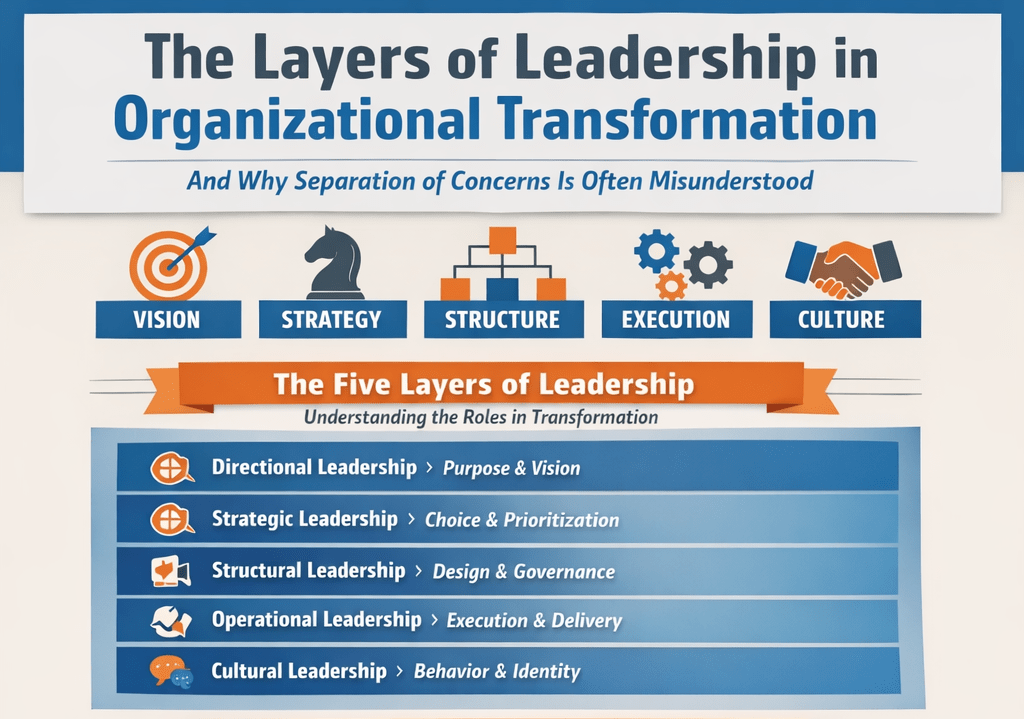
The Core Layers of Leadership in Transformation
Organizational transformation operates across five distinct yet interdependent leadership layers.
Layer 1 – Directional Leadership — Purpose & Vision
Directional leadership ensures that transformation is proactive rather than reactive.
Core question: Why are we transforming?
This is executive territory. It defines:
- Strategic intent
- Long-term positioning
- Narrative alignment
- External context (market, regulation, technological shifts)
Failure mode:
When executives debate tooling, workflows, or operational details instead of defining direction, the organization loses strategic altitude. Transformation becomes tactical noise.
Layer 2 – Strategic Leadership — Choice & Prioritization
Core question: What are we choosing — and what are we not choosing?
Strategic leadership makes these tensions visible and resolves them intentionally.
Strategy is about deliberate trade-offs. It includes:
- Portfolio prioritization
- Resource allocation
- Definition of success metrics
- Explicit trade-offs
Transformation always creates tension:
- Speed vs. stability
- Innovation vs. compliance
- Standardization vs. flexibility
Failure mode:
Trying to “do everything” to avoid political discomfort. This diffuses focus and exhausts capacity.
Layer 3 – Structural Leadership — Design & Governance
Structure ensures that authority is clear and accountability measurable. This is where Separation of Concerns becomes operational reality.
Core question: How are responsibilities structured?
This layer defines:
- Decision rights
- Role clarity
- Escalation paths
- Governance mechanisms
Failure mode:
Designing structures around personalities rather than roles. This creates fragility and dependency instead of resilience.
Layer 4 – Operational Leadership — Execution & Delivery
Transformation fails in execution when operational leaders lack either clarity or authority.
Core question: How do we deliver reliably?
Operational leadership translates direction into execution. It governs:
- Process design
- KPIs and performance metrics
- Milestones and delivery cadence
- Risk and dependency management
Transformation fails in execution when operational leaders lack either
Failure mode:
Strategy constantly interfering in day-to-day delivery. Overreach erodes ownership and slows performance.
Layer 5 – Cultural Leadership — Behavior & Identity
Cultural leadership ensures that people evolve without losing dignity.
Transformation reshapes:
- Incentives
- Behavioral norms
- Accountability culture
- Learning posture
Failure mode:
Attacking identity instead of evolving capability. When transformation feels like rejection rather than development, resistance becomes rational.
Why Separation of Concerns Is Pivotal
In transformation, every leadership layer interacts, but they must not override one another.
Separation of Concerns (SoC) ensures that:
- Direction does not collapse into micromanagement
- Governance does not suppress execution
- Execution does not redefine strategy
- Culture does not become accidental
Without separation:
- Escalations multiply
- Accountability blurs
- Emotional reactions replace structured decisions
- Speed decreases despite increased activity
With separation:
- Decision paths are clear
- Authority is respected
- Escalations are structured
- Accountability is measurable
In the end, sustainable transformation is not about constant intervention, it is about intentional design. Leaders must think like architects: defining interfaces, clarifying responsibilities, and ensuring that each layer strengthens the system rather than competes within it.
Separation of concerns does not fragment leadership.
It aligns it, and in transformation, alignment is the difference between motion and progress.
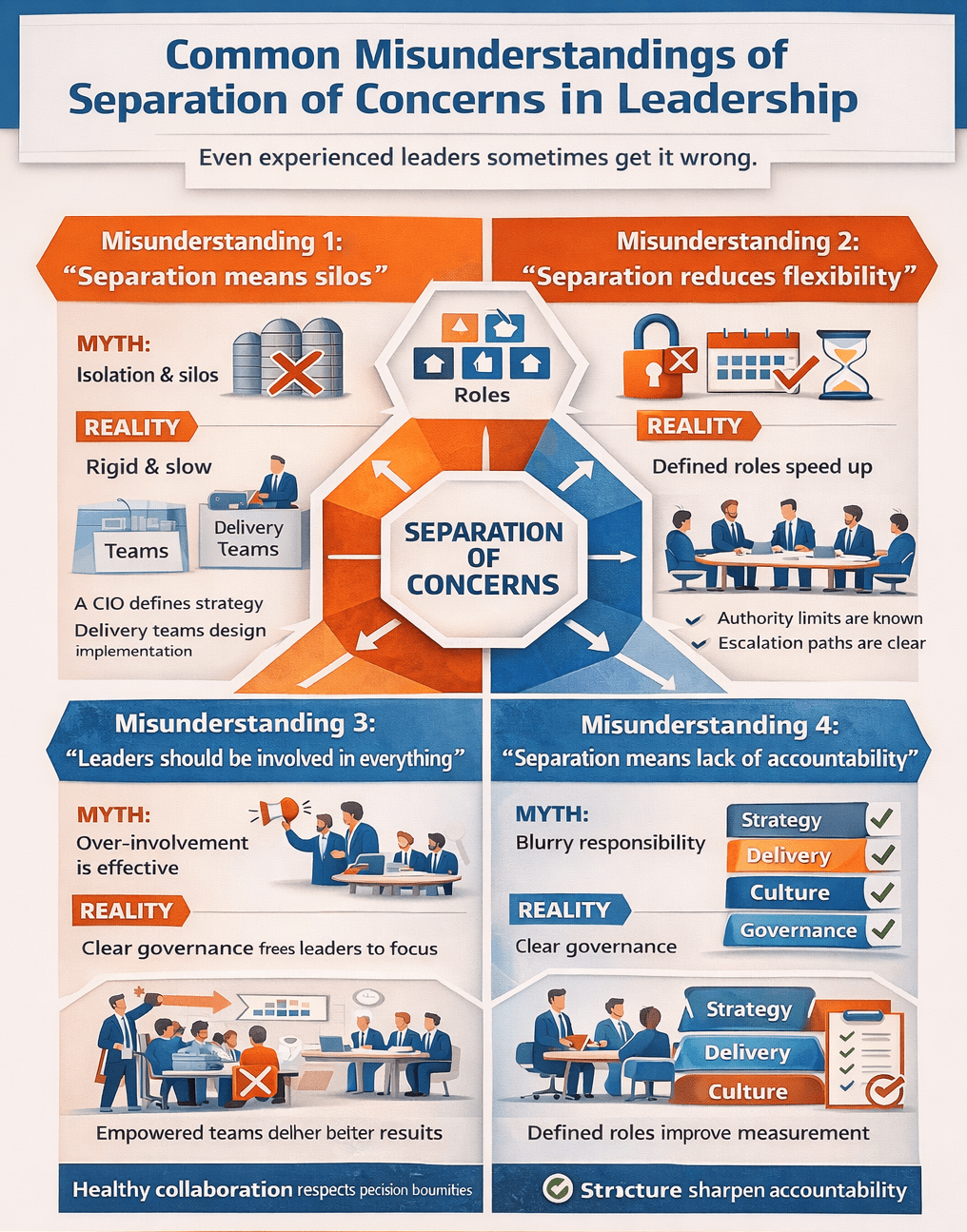
In the next part of this series, I will focus on the most common misunderstandings of Separation of Concerns in the context of Organizational Transormation.






Leave a comment