The Most Common Misunderstandings –
In the first part of this article series, we explored the importance of Separation of Concerns in leadership and discussed how different leadership layers carry distinct responsibilities within the context of organizational transformation.
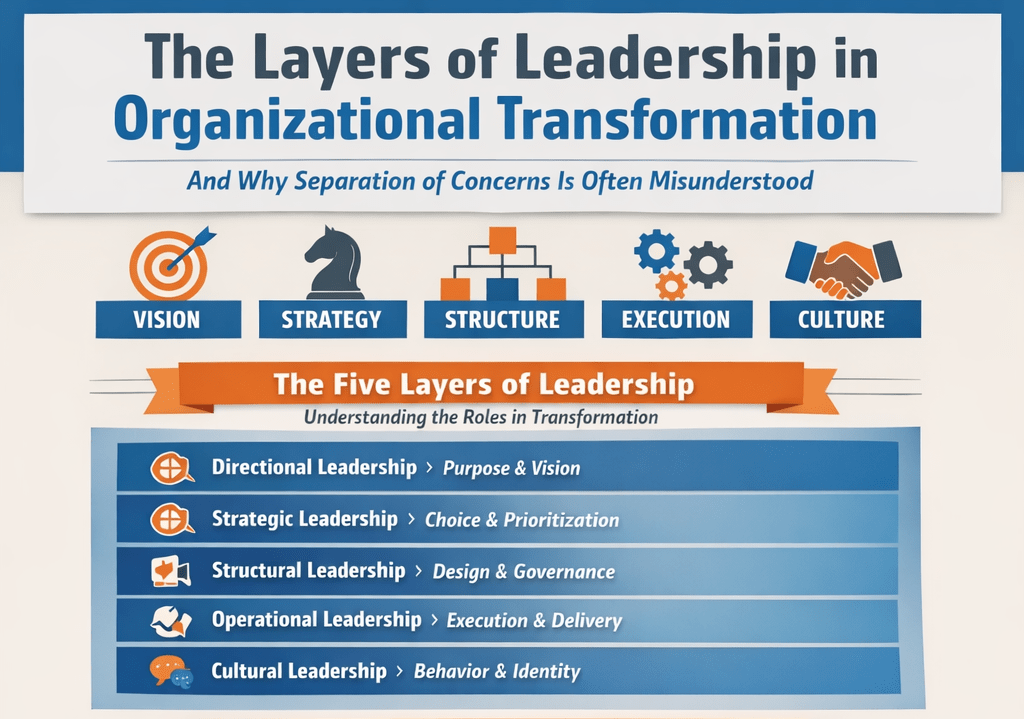
We examined how directional, strategic, structural, operational, and cultural leadership operate together, and why respecting these boundaries is essential for clarity, accountability, and effective execution.
In this second part, we turn our attention to a frequent challenge in transformation initiatives: misunderstanding the principle of separation of concerns itself. Even experienced leaders occasionally misinterpret this concept, often with unintended consequences.
Understanding these misconceptions is critical, because when separation of concerns is applied incorrectly, it can create exactly the problems it was meant to prevent.
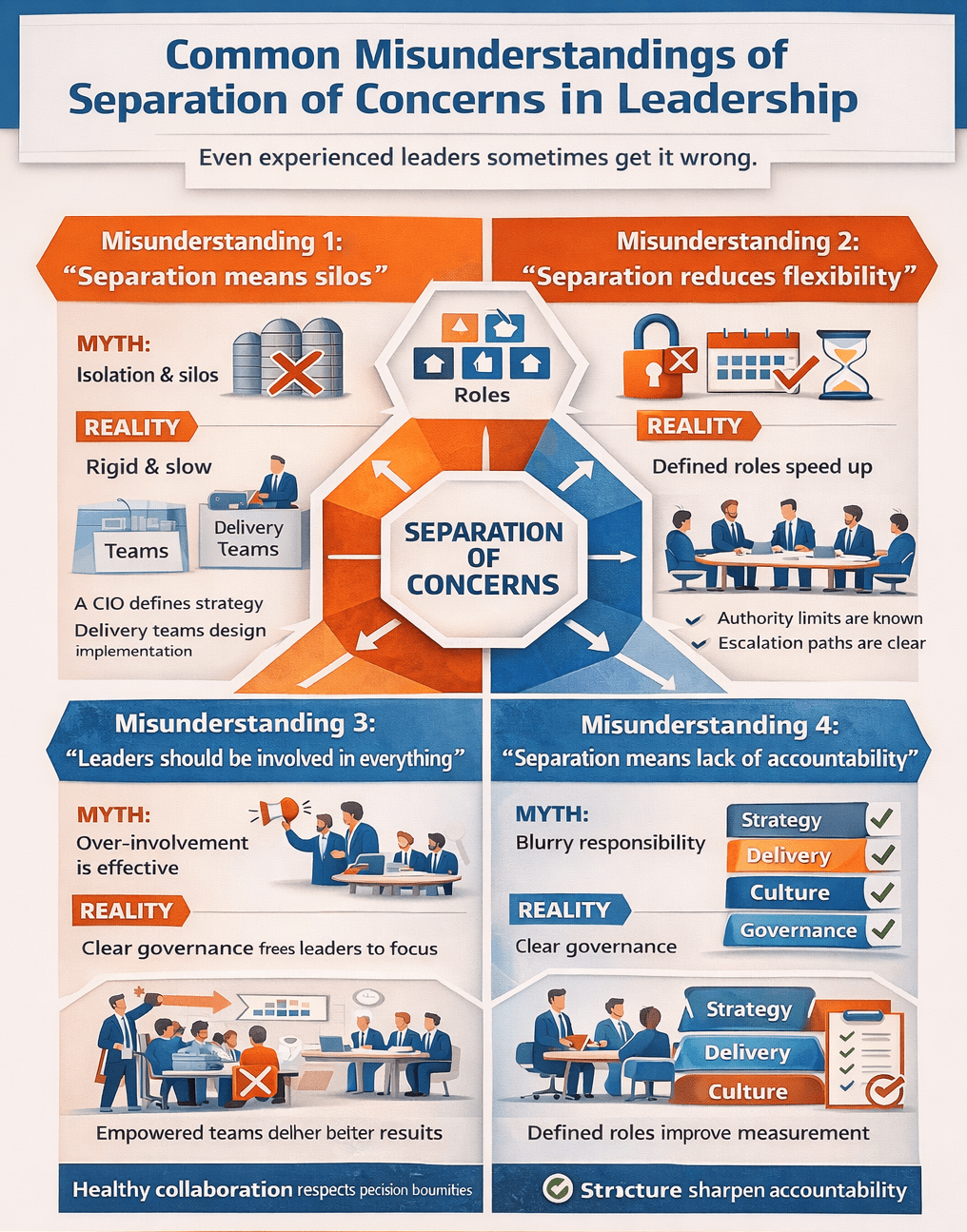
Misunderstanding 1: “Separation Means Silos”
A CIO defines a cloud-first strategy as part of the organization’s long-term technology direction.
Delivery and engineering teams then design the technical architecture and implementation path. The two layers collaborate continuously — but they do not exchange responsibilities.
The CIO does not design infrastructure pipelines, and engineering teams do not redefine corporate technology strategy.
The difference is subtle but important:
- Isolation means limited communication and fragmented thinking.
- Separation means clear responsibility combined with deliberate alignment.
Healthy organizations communicate constantly while maintaining clear decision boundaries.
Misunderstanding 2: “Separation Reduces Flexibility”
Another common concern is that defining boundaries slows down organizations or reduces agility. In practice, the opposite is usually true.
When responsibilities are unclear, decisions move upward unnecessarily. Executives become bottlenecks, operational teams hesitate to act, and progress slows.
Consider the alternative:
If every operational decision requires executive validation, delivery velocity collapses.
If operational teams begin redefining strategy on the fly, the organization loses coherence.
Clear separation accelerates decisions because:
- Authority limits are known
- Escalation paths are defined
- Ownership is protected
Structure does not reduce agility, it enables sustainable agility.
Misunderstanding 3: “Leaders Should Be Involved in Everything”
Transformation environments often generate a strong impulse among leaders to stay involved in every detail. This impulse is understandable: the stakes are high, uncertainty is constant, and outcomes matter deeply.
Yet high involvement does not equal effective leadership. In fact, over-involvement frequently produces the opposite effect:
Teams lose ownership
- Middle management becomes bypassed
- Decision paths become inconsistent
Instead of empowering the system, leaders unintentionally weaken it.
In transformation, leadership must focus on architecting the system rather than operating it.
Leaders should:
- Architect structures and governance
- Protect strategic direction
- Remove systemic obstacles
- Enable teams to succeed
They should not:
- Resolve every operational conflict
- Override established leadership layers
- Redesign execution mechanisms week by week
Leadership maturity is measured not only by action, but also by restraint.
Misunderstanding 4: “Separation Means Lack of Accountability”
Some organizations fear that separating responsibilities will dilute accountability. The reality is exactly the opposite.
When responsibilities overlap excessively, accountability disappears. Multiple actors influence outcomes, but no one truly owns them. Separation clarifies accountability because each layer has a distinct mandate.
For example:
- Strategy defines direction and priorities
- Governance defines structure and decision rights
- Operations delivers outcomes
- Culture shapes behavior and long-term capability
When these layers are clearly distinguished, each can be evaluated independently.
Separation of concerns does not reduce accountability, it sharpens it.
Conclusion
Organizational transformation is often portrayed as a test of courage, charisma, or decisive leadership.
As transformation progresses, complexity increases. Stakeholders multiply, decisions accelerate, and uncertainty becomes constant. In such environments, the temptation for leaders to intervene everywhere grows stronger.
Yet the paradox of transformation is simple:
The more complex the system becomes, the more disciplined leadership must be about where it acts and where it deliberately refrains.
Separation of concerns is therefore not a technical abstraction. It is a leadership discipline.
It demands:
- Humility to remain within one’s mandate
- Trust in adjacent leadership layers
- Clarity in defining boundaries before conflicts arise
When leadership layers blur, transformation becomes political and reactive. When those layers are respected, transformation becomes coherent and sustainable.
- Directional leadership sets the horizon.
- Strategic leadership defines the path.
- Structural leadership builds the framework.
- Operational leadership drives execution.
- Cultural leadership shapes identity.
Each layer depends on the others, yet none can function effectively if constantly overridden. Leaders must think like architects: defining interfaces, clarifying responsibilities, and ensuring that every layer strengthens the system rather than competing within it.
Separation of concerns does not fragment leadership.
It aligns it.
And in transformation, alignment is the difference between motion and progress.